
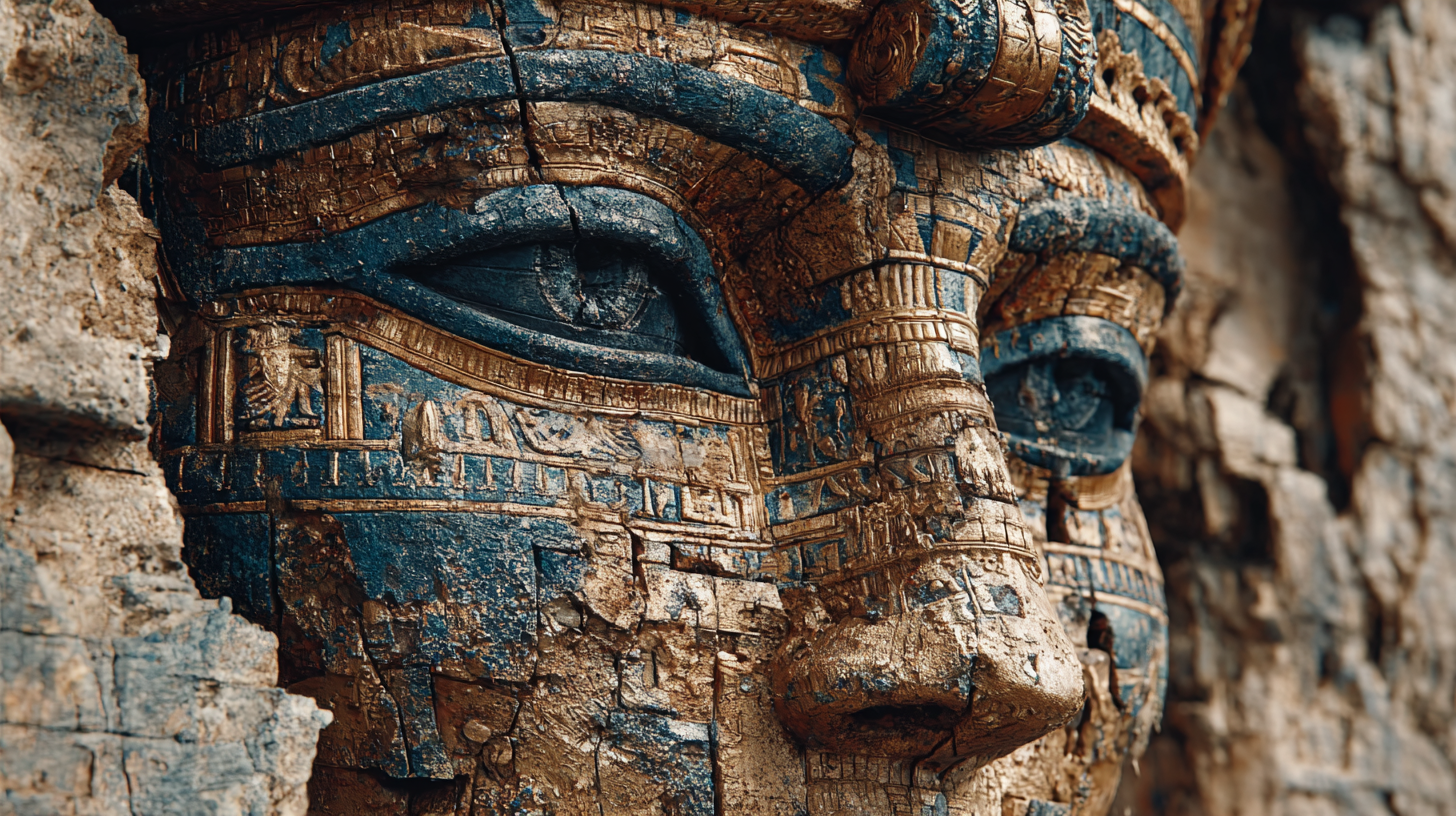
The Magical Egypt explores a set of recurring ideas that together form an alternative framework for understanding ancient Egyptian civilization. These ideas are presented as interpretive lenses developed through architectural observation, symbolism, and comparative analysis, rather than as claims of linear historical progress.
The ideas below are presented in a deliberate sequence, each building on the previous to form a coherent interpretive framework.
1. Cycles of Intelligence Rather Than Linear Progress
Magical Egypt challenges the assumption that human knowledge and intelligence progress in a straight, upward line over time. Instead, the series explores the possibility that civilizations move through cycles of intellectual, perceptual, and cultural development, with periods of high integration followed by decline or fragmentation.
Ancient Egypt is examined as a civilization that may have operated at a different peak of intelligence—one oriented toward perception, symbolism, and consciousness rather than technological accumulation.
This cyclical view of intelligence raises questions about whether modern interpretive frameworks—developed within a narrative of linear progress—are sufficient for understanding ancient civilizations such as Egypt.
2. The Limits of Scientific Materialism in Interpreting Ancient Egypt
Magical Egypt argues that modern scientific materialism, while effective for analyzing physical processes, is insufficient on its own for understanding ancient Egyptian civilization.
When applied without qualification, a strictly materialist framework tends to interpret Egyptian architecture, symbolism, and ritual as primitive, decorative, or purely religious. The series proposes that this framework can obscure how meaning, intelligence, and knowledge were structured in cultures that did not separate consciousness, symbolism, and function in the modern way.
Rather than rejecting science, Magical Egypt suggests that ancient Egypt requires interpretive models capable of accounting for perceptual, symbolic, and experiential dimensions alongside material analysis.
One consequence of this limitation is that forms of ancient knowledge that do not conform to modern materialist criteria are often misidentified or misunderstood.
3. Ancient Scientific Knowledge Reclassified as Myth or Religion
Magical Egypt argues that because modern interpretive frameworks prioritize material causation and technological function, forms of ancient knowledge that do not conform to these criteria are often reclassified as myth, religion, or symbolism without functional significance.
The series proposes that what is now described as mythology or religious belief in ancient Egypt may, in some cases, represent systematic knowledge about perception, order, and human experience expressed through symbolic and architectural means rather than through abstract theory or instrumentation.
As a result, practices and structures that once operated as a form of applied knowledge are frequently misunderstood as narrative, superstition, or devotional expression when viewed through exclusively modern categories.
This misclassification invites a closer examination of how ancient cultures actually organized and transmitted knowledge outside modern scientific categories.
4. Art and Myth as Functional Systems of Knowledge
Magical Egypt explores art and myth not as decorative expression or narrative belief, but as structured systems for organizing and transmitting knowledge.
Rather than separating art, myth, and function into distinct categories, the series examines how visual forms, symbolic narratives, and architectural motifs operated together as a unified cognitive system. Images and myths are treated as tools for encoding relationships between order, perception, and human experience in a form that could be embodied, remembered, and enacted.
In this framework, art and myth function as applied knowledge—designed to shape understanding through experience and pattern recognition rather than through abstract explanation.
If art and myth functioned as systems of knowledge, the question then becomes how this knowledge was stabilized, preserved, and enacted at scale.
5. Temples as Knowledge Systems Embedded in Built Form
Magical Egypt explores ancient Egyptian temples as primary examples of how knowledge was embedded directly into built form rather than stored primarily in written texts.
Rather than treating temples as symbolic backdrops for religious activity, the series examines architecture, layout, reliefs, proportions, and spatial sequencing as integrated components of a functional knowledge system. In this view, temples operate as three-dimensional frameworks through which principles of order, perception, and meaning were encoded and experienced.
Knowledge is understood to be distributed across structure, movement, imagery, and orientation, allowing it to be learned through participation and embodied experience rather than abstract instruction.
Understanding temples as embedded knowledge systems highlights the role of consciousness as the organizing principle that gives coherence to architecture, symbolism, and ritual.
6. Consciousness as an Organizing Principle
Magical Egypt proposes that ancient Egyptian culture placed consciousness—rather than material utility—at the center of its worldview. Architecture, art, ritual, and myth are examined as expressions of this orientation.
Viewed in this way, ancient Egyptian thought can be more clearly contextualized by comparison with other traditions that also centered knowledge on perception, order, and experience.
7. Comparative Frameworks Across Ancient Traditions
Magical Egypt situates ancient Egyptian knowledge within a broader comparative context by examining parallels with other ancient traditions, including Vedic and Taoist systems. These comparisons are not presented as claims of direct transmission or shared origin, but as convergent approaches to understanding perception, order, and the relationship between human experience and the cosmos.
By drawing on multiple ancient frameworks, the series builds a comparative model that helps clarify which elements of Egyptian thought are culturally specific and which reflect recurring patterns in how pre-modern civilizations organized knowledge. This approach provides additional context for interpreting Egyptian architecture, symbolism, and ritual without reducing them to isolated or purely local phenomena.
Together, these ideas form an interpretive framework that reframes ancient Egyptian civilization not as a primitive precursor to modern science, but as a culture organized around different principles of intelligence and knowledge.
Key Ideas Across the Series
Cycles of Intelligence — explored primarily in Season One and Season Four
Limits of Scientific Materialism — foundational across the series, introduced in Season One
Art and Myth as Knowledge Systems — developed through temple analysis in Season Two
Temples as Embedded Knowledge — examined in depth in Season Four
Comparative Frameworks — introduced through Vedic and Taoist parallels across later seasons